There have been few opportunities for capturing night sky objects owing to clouds and the presence of the Moon. That doesn’t stop me from trying.
Comet 12P/Pons-Brooks and Triangulum Galaxy (M33).
Comet 12P/Pons-Brooks and M33 (Triangulam Galaxy).
Clouds, a bright waxing Moon, and some distant light pollution made it difficult to capture this comet. This was taken at the base of Arizona Snowbowl ski area at 2830 m; the elevation helps to get above some of the atmospheric haze.
Sunspots AR3615 and AR3614
Several large sunspots are visible on the face of the Sun (27 March 2024).
Zodiacal Light
Zodiacal light, Jupiter, and Comet 12P/Pons-Brooks (28 March 2024).
While setting up to photograph a launch at Vandenberg SFB (which was scrubbed), I fired off a few test shots of the zodiacal light. In review, I noticed that I also captured Comet 12P/Pons-Brooks. Small–very small–when shot with a 24mm wide-angle lens.
Now, the Moon is out of the way and the forecast indicates a few clear nights so maybe I’ll get another change to shoot some images of the comet.
Venus and the Pleiades star cluster are prominent in the center of the image while Mercury is about to set in the low gap. The zodiacal light is also faintly visible.
Upper Lake Mary, Flagstaff, Arizona; 10 April 2023.
Venus, Mercury, Pleiades, and Zodiacal light all reflected in Lake Mary.
With exceptionally clear skies it was a good time to capture images of the zodiacal light. Here is what Wikipedia has to say about this astronomical phenomenon.
Zodiacal light is a faint, roughly triangular, diffuse white glow seen in the night sky that appears to extend up from the vicinity of the Sun along the ecliptic or zodiac. It is best seen just after sunset and before sunrise in spring and autumn when the zodiac is at a steep angle to the horizon. Caused by sunlight scattered by space dust in the zodiacal cloud, it is so faint that either moonlight or light pollution renders it invisible.
Zodiacal Light. (28mm lens)Zodiacal Light and light pollution. (16mm lens)
Both images above clearly show the cone of light extending upward. In the upper portion of both images is the Pleiades star cluster with the planet Mars just below and to the left.
Light pollution from Phoenix makes star viewing a challenge.
It’s unfortunate that Arizona’s dark skies aren’t as dark as they could be. Increasing population and expanding cities throws more light into the night sky. And our state legislators seem to think that bright billboards are more important than the dark skies needed by the many telescopes located in the state.
The past week has been bountiful for photographing objects in the night sky. These objects include Mercury, Venus, Mars, the Moon, and the Zodiacal Light.
In mid-March the planet Venus was an evening object but was dropping closer to the horizon each evening. At the same time, Mercury was rising higher each day. On 18 March 2017, they were roughly side by side and presented an interesting spectacle in the evening twilight.
Venus and Mercury in the evening twilight above the Kachina Wetlands. Venus can be seen just to the right of center of the image; Mercury is left of center.
The following night I returned to Kachina Wetlands but later in the evening to capture the Zodiacal Light. The Zodiacal Light is a faint, roughly triangular, diffuse white glow seen in the night sky that appears to extend up from the vicinity of the Sun along the ecliptic or zodiac.
Zodiacal Light (28mm focal length).
A week later I attempted the same photograph except using an ultra-wide angle lens (i.e., 16mm focal length) to capture the Zodiacal Light as well as the constellation Pleiades in the upper portion of the cone of light.
Zodiacal Light (16 mm focal length).
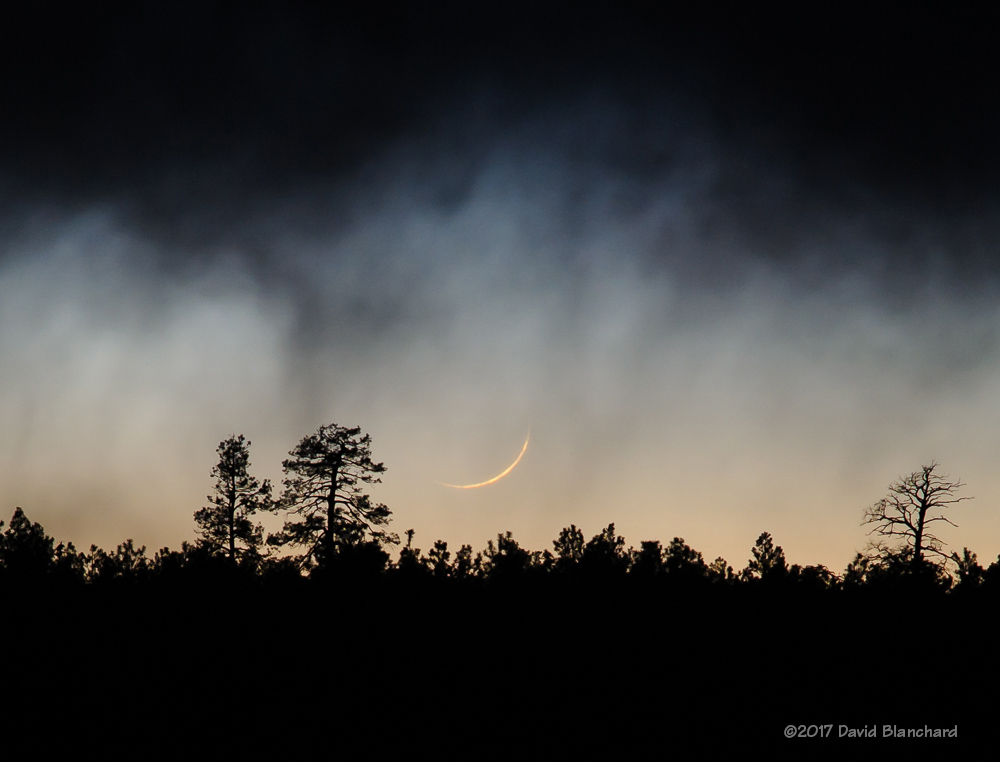
A few days later, the moon had reappeared in the evening sky. With just 1.4% of the disk illuminated it can be difficult to see. Making it much harder was the showery weather and abundance of clouds. But just before the moon set behind the trees it was visible in the gap below the clouds and the horizon.
A bonus was the very nice sunset colors reflected in the waters of Lake Mary while waiting for the moon to make an appearance.
Sunset colors reflected in Lake Mary.Crescent Moon.
One day later, I tried again. This time the skies were clear and it was possible to capture an image with the 3M’s: Mercury, Mars, and the Moon. While waiting for the sky to darken enough for the planets to become visible I was able to capture an image of the moon with sunset colors still visible.
Crescent Moon above Lake Mary.
As twilight faded away Mercury and Mars became visible and the triplet made a triangle in the western sky.
Mercury, Moon, and Mars in the evening sky. Mercury is located at the “4 o’clock” position relative to the Moon; Mars in at the “12:30 position.”Mercury, Moon, and Mars in the evening sky.
An active weather pattern is in place across the southwest at this time and it may be several days before the skies become clear again.