North American Monsoon—July 2026

Distant storms produce large anvils with mammatus on the undersides.

We are once again in the North American Monsoon season. This year’s monsoon began slowly with a few false starts in early July but arrived in earnest by the middle of the month. And what a wet period the second half of the month was over parts of northern Arizona. Rainfall measured at the Flagstaff airport was 3.63″ compared to the 30-year (1991–2020) average of 2.61″ and the total period of record (1898–2026) of 2.74″.

07 July 2026

The summer monsoon hadn’t really started yet—but there was enough moisture available to get a few cumuliform clouds and a nice sunset. It was a good practice session for what was to follow.

Light from the setting sun illuminates the base of clouds over Anderson Mesa in northern Arizona.
A few clouds glow with the light of the setting sun while smoke from the Pocket Fire can be seen just above the horizon.

18 July 2026

Monsoon moisture finally arrived and big storms were present. The sunset light on the clouds and rain was remarkable!

Several large thunderstorms over central Arizona.
As the sun set it illuminated both clouds and rain creating this amazing red sunset sky.
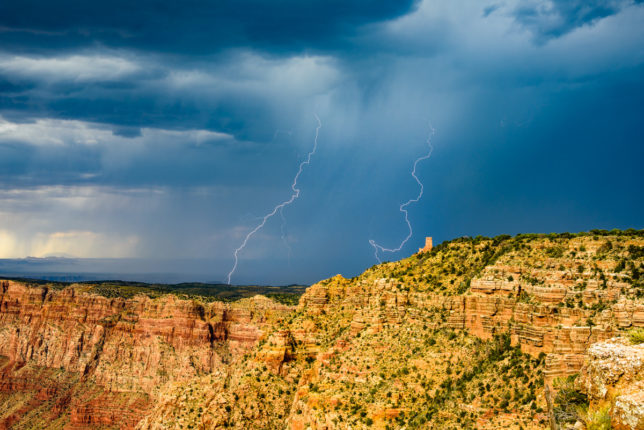
Add a bit of lightning and the sky becomes truly wild.
A few more lightning flashes light up the sky with the San Francisco Peaks visible in the distance.
Cool, moist outflow from distant storms created this impressive shelf cloud.

Continue reading →

Comet C/2025 R3 (PanSTARRS)—April 2026

Comet C/2025 R3 (PanSTARRS) on 17 April 2026. Photographed from the west side of Mormon Lake. Nikon D850, 35mm, ƒ/1.8, ISO 200, 2x120 seconds (composite of two images: one for the foreground; one for the sky).

I was very happy to be able to see and to photograph Comet C/2025 R3 (PanSTARRS) during a two-week period in the middle of April. Later in the month it became more difficult to see the comet in the morning twilight. After it made its closest approach to the Sun it flipped into the evening sky but by that time it was best seen from the Southern Hemisphere. Those of us in the Northern Hemisphere had already had a great show from this comet.

From Wikipedia:

C/2025 R3 (PanSTARRS) is a hyperbolic Oort cloud comet and passed perihelion on 19 April 2026 when it was 75 million km from the Sun. Around perihelion it reached about an apparent magnitude of +3. The comet was discovered by PanSTARRS in images obtained on 8 September 2025. By 20 March 2026 it became visible in 10×50 binoculars. As of May, the comet has faded, moved into the southern skies, and will require binoculars or a camera to locate.

I photographed the comet from two locations: the west side of Mormon Lake in the small pullout; and from Ashurst Lake overlooking the water. I was hoping for some reflections of the comet in the lake waters (as I had from Comet C/2023 A3) but was not successful.

Here are several photographs of Comet C/2025 R3 (PanSTARRS) from April 2026.

Comet C/2025 R3 (PanSTARRS) on 09 April 2026. Photographed from the west side of Mormon Lake. Nikon D850, 80mm, ƒ/4.0, ISO 400, 8x60 seconds. Images stacked with Siril.
Comet C/2025 R3 (PanSTARRS) on 09 April 2026. Photographed from the west side of Mormon Lake. Nikon D850, 80mm, ƒ/4.0, ISO 400, 8×60 seconds. Images stacked with Siril.
Comet C/2025 R3 (PanSTARRS) on 12 April 2026. Photographed from Ashurst Lake. Nikon D850, 35mm, ƒ/1.8, ISO 100, 2x240 seconds (composite of two images: one for the foreground; one for the sky).
Comet C/2025 R3 (PanSTARRS) on 12 April 2026. Photographed from Ashurst Lake. Nikon D850, 35mm, ƒ/1.8, ISO 100, 2×240 seconds (composite of two images: one for the foreground; one for the sky).
Comet C/2025 R3 (PanSTARRS) on 15 April 2026. Nikon D850, 180mm, ƒ/4.0, ISO 800, 16x120 seconds. Stacked with Siril.
Comet C/2025 R3 (PanSTARRS) on 15 April 2026. Nikon D850, 180mm, ƒ/4.0, ISO 800, 16×120 seconds. Stacked with Siril.
Comet C/2025 R3 (PanSTARRS) on 15 April 2026. Nikon D850, 180mm, ƒ/4.0, ISO 800, 16x120 seconds. Stacked with Siril then inverted into a black-and-white negative image.
Comet C/2025 R3 (PanSTARRS) on 15 April 2026. Nikon D850, 180mm, ƒ/4.0, ISO 800, 16×120 seconds. Stacked with Siril then inverted into a black-and-white negative image.
Comet C/2025 R3 (PanSTARRS) on 15 April 2026. Nikon D850, 180mm, ƒ/4.0, ISO 800, 16x120 seconds. Stacked with Siril then star removal using StarNet software.
Comet C/2025 R3 (PanSTARRS) on 15 April 2026. Nikon D850, 180mm, ƒ/4.0, ISO 800, 16×120 seconds. Stacked with Siril then star removal using StarNet software.
Comet C/2025 R3 (PanSTARRS) on 17 April 2026. Photographed from the west side of Mormon Lake. Nikon D850, 35mm, ƒ/1.8, ISO 200, 2x120 seconds (composite of two images: one for the foreground; one for the sky).
Comet C/2025 R3 (PanSTARRS) on 17 April 2026. Photographed from the west side of Mormon Lake. Nikon D850, 35mm, ƒ/1.8, ISO 200, 2×120 seconds (composite of two images: one for the foreground; one for the sky).

In July/August, Comet 10P/Tempel 2 should be a good camera target although it is not expected to reach unaided eye brightness.

Milky Way–June 2025

In late June we had an extended string of days/nights without clouds. So this was a good time to update my Milky Way photographs using an ultra-wide fisheye lens. I did a similar photo shoot in May of last year. As before, I shot from a pullout on the Mormon Lake Village road which gives me a clear view over the top of the lake.

Image of Milky Way over Mormon Lake.
Image of Milky Way with star reduction.

The big difference between last year and this year is a new camera. I upgraded from my Nikon D750 to a Nikon D850. The latter has 45 megapixels; the former has 24 megapixels. Big difference and it should result in better resolution of the stars.

I shot two sets of photographs. One set was on an iOptron SkyTracker to follow the motion of the stars; the second set was without tracking to photograph the foreground. Exposure time for both was 300 seconds and were shot with a Rokinon 12mm F2.8 full frame fisheye lens. As a consequence of the fisheye lens the Milky Way appears curved.

The two sets of images (foreground, stars) were then blended together using Photoshop. The result was imported into Siril, an astrophotography software package, to reduce the stars using the Starnet package. Both the normal star image and the reduced star image are shown here.

It should be noted that there was a lot of airglow that evening and the reduced star image helps to see the structure and waves present in the airglow.

It was a successful and fun evening of astrophotography shooting.

Comet C/2023 A3 (Tsuchinshan-ATLAS)–Morning Observations

Comet C/2023 A3 (Tsuchinshan-ATLAS) has been in the headlines and the morning sky for a few weeks. Yeah, some of the headlines and news articles are over-the-top but most of them are quite good. And the comet in the morning twilight has been fun to photograph.

Comet C/2023 A3 (Tsuchinshan-ATLAS) and Ashurst Lake, Flagstaff, Arizona.

I have taken photos on five different mornings over a nine-day period and have captured images of the comet growing brighter and the tail growing longer. On only one occasion was I able to see the comet with the unaided eye. On three occasions I was able to see it with binoculars. On all five mornings it was very easy to capture the comet with even very short exposures on the camera.

The comet is now getting very close to the Sun so I have suspended photography for a few days. When it reemerges in the evening sky I will once again start shooting photos. I hope it is easier to see during this phase.

I shot the comet with a few different focal lengths (50mm, 85mm, and180mm). I think the best images were with the 85mm f/1.8 lens (usually shot at f/2.8) as it gave a wide-enough view to include some foreground.

Here are some photographs and time-lapse video from the period 25 September through 03 October.

25 September 2024

This was my first attempt to photograph the comet. It was taken from the overlook on Mars Hill, home of Lowell Observatory, in Flagstaff. The comet is small and located in the upper middle of the photograph. I often shoot photos of astronomical objects in the eastern sky from this location because I can include much of the city.

Comet C/2023 A3 (Tsuchinshan-ATLAS) and the City of Flagstaff. (25 September 2024)

26 September 2024

I was planning on returning to Mars Hill but smoke from a managed wildfire suggested I should try elsewhere. I ended up at the Mormon Lake Overlook. The first image is a stack of 16 images taken over the course of about five minutes. The stacking increases the signal, reduces noise, and allows more stretching of the histogram to pull out the faint details.

The video was taken from the same set of images but without any cropping. The camera was mounted on a star tracker so that the comet remained fixed in the images.

A stack of 16 images taken over the course of about five minutes. (26 September 2024)

Time-lapse video of the comet rising above the eastern horizon. (26 September, 2024)

28 September 2024

With some smoke still present I returned to the Mormon Lake Overlook on this morning. I was disappointed at the clouds but afterwards decided that I really liked the image of the clouds partially obscuring the comet tail.

Clouds partially obscure the tail of the comet. (28 September 2024)

October 01 2024

I went to Ashurst Lake for this photo session with the hopes of catching a reflection of the comet tail in the calm waters of the lake. I was not disappointed!

In the first image, the comet has not risen above the horizon but the comet tail is strikingly visible in the sky and reflected in the water. In the second image, the comet has barely cleared the trees, the tail is still quite bright, but the reflection on the water has dimmed. Next, the waning crescent Moon rises–and is partially behind a cloud–as the sky brightens making the comet’s tail more difficult to see. The final image is a stack of six images and cropped to show only the comet and tail.

The tail of the comet is reflected in the still waters of Lake Ashurt, near Flagstaff, Arizona. (01 October 2024)
The comet has risen above the trees and the tail remains strikingly visible while the reflection has dimmed.
The crescent Moon joins the scene in the eastern twilight. The sky has brightened making it more difficult to see the tail. (01 October 2024)
Close up of the comet and tail in the bright twilight. (01 October 2024)

October 03 2024

My goal on this morning was to shoot a long sequence of images so that I could produce a time-lapse video starting when the comet was below the horizon until twilight became too bright to see the comet. Again, I was at Ashurst Lake hoping for reflections or smooth water. Success!

The first image was taken ~14 minutes before the comet rose above the horizon but the tail is still easily visible.

The comet is below the horizon but the tail extends well up into the twilight sky. (03 October 2024)

Time-lapse video of the comet rising during the period 0503–0533 MST. (03 October 2024)

As I mentioned at the beginning, there have been many articles about the comet. I think this one from Sky and Telescope is one of the better ones. Also, EarthSky.org has published many beautiful photos of the comet.

The best is yet to come!

North American Monsoon–August 2024

A curtain of light rain from a dissipating thunderstorm is brilliantly illuminated by the setting sun.

Storms in August were more plentiful than in July although there were still some extended breaks in the monsoon. Rainbows remained elusive for me. I was able to photograph a few that displayed short segments but I never captured a full rainbow. Lightning, on the other hand, was plentiful and I did well in that genre.

Here is a partial summary of August monsoon photography.

04 August 2024

Mormon Lake Overlook is a short drive from Flagstaff and affords an amazing 360° view. This was one of the many days with only a partial rainbow but the juxtaposition of the rainbow and the tree in the grasslands of Anderson Mesa was a pleasing composition. A few minutes later the Sun beautifully illuminated some light rain falling from a dissipating thunderstorm. The color was intense and only lasted a few minutes.

A short segment of a rainbow above the grasslands of Anderson Mesa in northern Arizona.
A curtain of light rain from a dissipating thunderstorm is brilliantly illuminated by the setting sun.

Continue reading →